This page contains affiliate links. If you buy through them we may earn a commission, at no extra cost to you. It never changes our verdicts.
Babbel review 2026: is Babbel worth it?
Babbel is worth paying for if you want structured, dialogue-based courses with grammar explained, and you can commit to short daily lessons for several months. It is less worth it if you want a free app, a very wide choice of languages, or live lessons with a teacher. Prices below were checked on 21 October 2026 on Babbel’s official prices page and should be checked again before you buy.
What Babbel is
Babbel is a paid language-learning app with courses for a set of major languages. Its course pages describe lessons of five to ten minutes, with levels that run from beginner (A1) to upper-intermediate (B2) on the French course (Babbel French course). The course is built around dialogues, grammar explanations and cultural tips, and uses spaced repetition to revisit vocabulary.
Babbel’s official prices page says that every plan includes all 14 languages (Babbel prices). Babbel does not teach Arabic.
Babbel at a glance
| Babbel | |
|---|---|
| Access | Paid subscription. A free lesson is available to try (Babbel French course) |
| Plans | 3-month, 6-month and 12-month subscriptions, and Babbel Lifetime (one-time payment) |
| Languages | 14, included in every plan. No Arabic |
| Lesson length | Five to ten minutes, per Babbel’s own course page |
| Course style | Levelled courses (CEFR), dialogues, grammar and culture tips |
| Speaking | Voice recognition and Babbel Speak pronunciation practice (vendor claims) |
| US App Store rating | 4.7 from about 757K ratings |
We took Babbel’s free first lesson on 21 October 2026, in the web app with its French interface. The account was a free one the owner had already created, and the course was Spanish taught from French, not English. We did not time the set-up from installing the app, and we did not take the placement quiz that the dashboard offers next to Lesson 1, so we cannot say whether it places a beginner at a sensible level. Because the account already existed, we also cannot say whether a new user has to sign up before the first lesson.
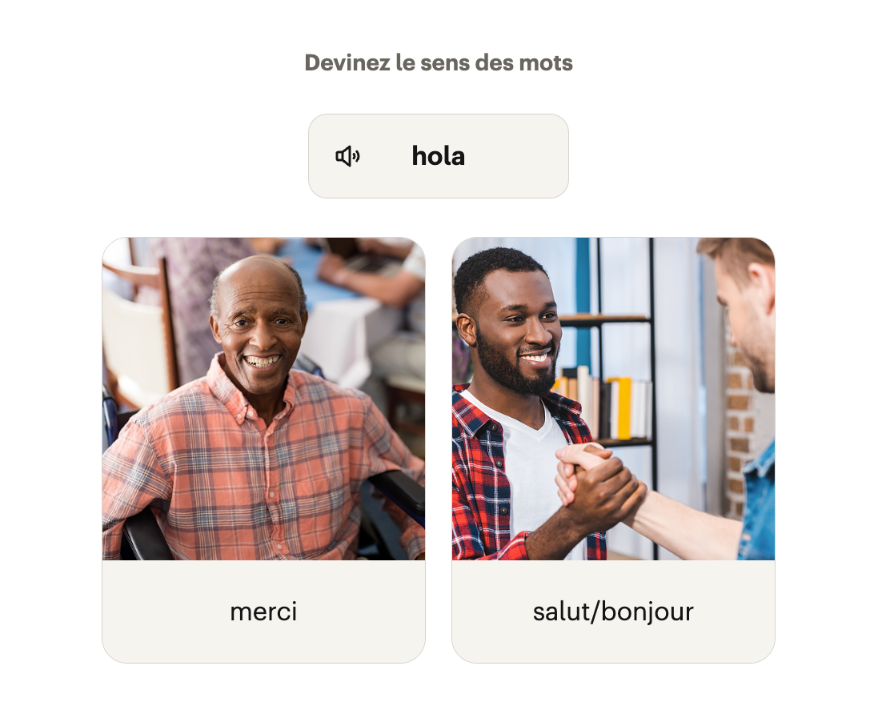
Lesson 1, picture-word exercise. The interface is in French.
Pricing
Babbel’s official prices page shows prices in euros for France, checked on 21 October 2026 (my.babbel.com/fr/prices):
- 3 months: €47.97, billed every 3 months (€15.99 per month).
- 6 months: €71.94, billed every 6 months (€11.99 per month).
- 12 months: €95.88 per year (€7.99 per month).
- Babbel Lifetime: €299.99, one-time payment.
The same page says that auto-renewal can be cancelled at any time. Per month, the 12-month plan costs about half the monthly price of the 3-month plan.
After lesson 1, opening the dashboard again led to the prices page. It showed the 3-month and 12-month plans and Babbel Lifetime at the prices above, and a banner on the page offered 20% off Babbel Lifetime with a countdown timer.
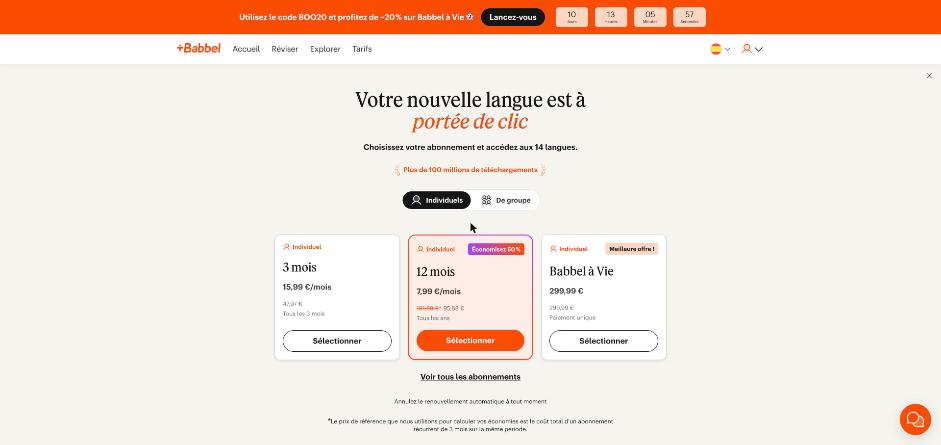
The prices page shown after lesson 1, 21 October 2026.
For reference only, the US App Store listing shows prices in US dollars: $17.99 for a one-month plan for a single-language course, $45.99 for three months, and $107.99 for a 12-month All Languages plan (Babbel on the US App Store). These are US App Store prices and do not apply in Europe. Third-party price guides report slightly different figures, for example $17.95 a month and $107.40 for 12 months (Copycat Cafe).
What the course covers
The French course is organised by level, and each lesson mixes listening, speaking and writing exercises with grammar notes. The vendor says the voice recognition tool helps learners get to conversational practice, and the Babbel Speak feature helps with pronunciation (Babbel French course). These are the company’s claims. We have not verified how well the feature works in practice.
Every plan includes all 14 languages, so the choice is about how long you commit, not how many courses you unlock.
Lesson 1 of the Spanish course has 8 screens and 19 scored answers. We got 17 right, and both misses were on listening questions. The exercises run from picture-word recognition and matching to building a word from syllables, dialogue gap-fills and sentences built from chunks after listening. Each line of the dialogue has its French translation underneath, and a wrong answer can be retried straight away on the same screen, with no hearts or lives to lose. Lesson 1 has no grammar tips. We did not evaluate two weeks of a course: the free account reaches lesson 1 only, so we cannot say how many lessons each level holds or whether the review exercises come back at the right moments.
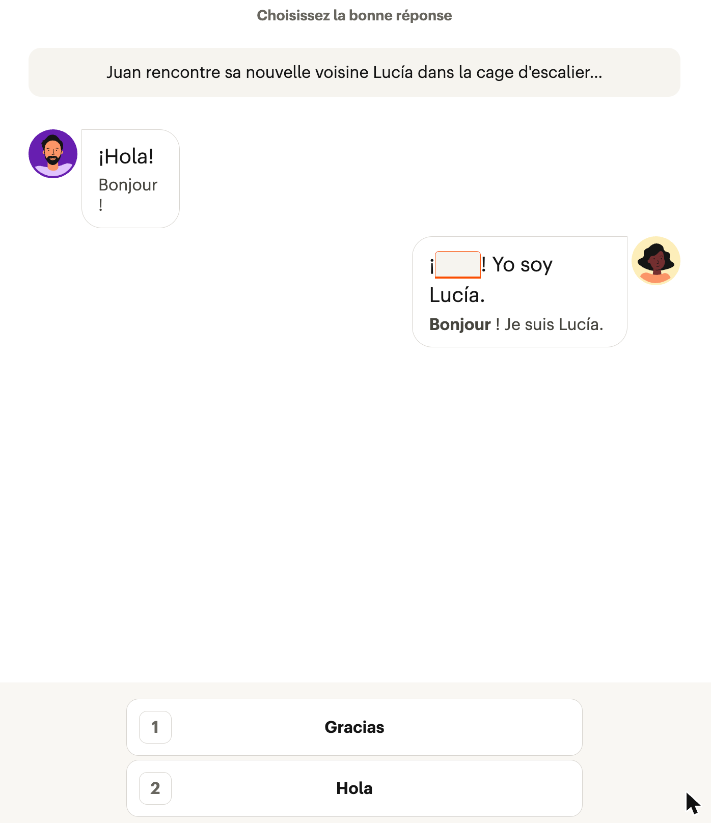
Lesson 1, dialogue exercise. Each line is translated into French.
Before you subscribe
A few checks take five minutes and can save you money:
- Choose the length of commitment. The official page lists 3-month, 6-month and 12-month plans, plus Lifetime at €299.99. Annual plans cost less per month, but you are committed for a year. A three-month plan lets you see whether the habit sticks before you pay for longer. Lifetime only makes sense if you are sure you will keep using the app.
- Check the renewal date. Auto-renewal can be cancelled at any time, according to the official page. Note the renewal date before it comes around.
- Start with the free lesson. Use it to judge the lesson style, the speed and whether the explanations suit you. If the free lesson feels slow or childish, a paid course will feel the same.
- Check the price on the vendor’s site. Prices differ by country and change over time, and the US App Store and third-party guides can differ from babbel.com. Take the price shown at checkout as the final figure.
How to get value from a paid course
A subscription only pays off if you use it. A realistic routine is one lesson a day, plus one review session a week to recheck the grammar points you find hard. Keep a short list of words or phrases that you got wrong, and read it before each lesson. Use the speaking exercises even when you feel awkward, because the feedback is the part of an app that a textbook cannot give you.
Babbel works best as the structure in a wider routine: reading simple texts in the language, listening to podcasts or films aimed at learners, and speaking with a person once you reach the intermediate levels. The app gives you the path. You still need to walk it.
Speaking practice
Speaking is the hardest part of learning with any app. Babbel says its voice recognition and Babbel Speak features help with pronunciation in conversational practice. Whether that feedback is useful depends on how accurately the app hears you and how specific its corrections are, and those points need to be tested rather than assumed.
We did not evaluate speech recognition. Our test could not hear audio or speak, and lesson 1 on the web had no speaking exercise. We cannot say whether the app accepts, corrects or rejects correct speech.
Pros and cons
Pros
- Structured levels that map to CEFR, which makes progress easy to measure.
- Short lessons that fit into a daily routine.
- Grammar and culture notes included in each course.
- A free lesson to try before paying.
- All 14 languages come with every plan.
Cons
- Paid, with no free plan beyond the trial lesson.
- 14 languages and no Arabic, so a less common language may not be available.
- Speaking feedback is only as good as the speech recognition, which still needs checking.
- Progress depends on consistent daily practice, which a subscription does not enforce.
Who Babbel is worth it for
Babbel is a good fit if you:
- want a structured course with grammar explained,
- are learning one of the main languages Babbel offers,
- are willing to pay a subscription or a one-time Lifetime fee,
- study better with a set path and clear levels.
Babbel is probably not worth it if you:
- want to learn for free,
- need a language that Babbel does not offer, such as Arabic,
- want live lessons or a teacher to correct your speaking,
- prefer a short, game-style app to a course.
For a comparison with the free option, see Babbel vs Duolingo: which one to pick in 2026. For the French version of this comparison, see Babbel ou Duolingo : lequel choisir ?.
Frequently asked questions
Is Babbel worth it? For structured, grammar-based learning that you can pay for, yes. For a free app or a wide choice of languages, it is usually not the best option.
Is Babbel free? Babbel offers a free lesson to try. The full course needs a subscription (Babbel French course).
How much does Babbel cost per month? On Babbel’s official prices page (euros, France, checked 21 October 2026), the 12-month plan is €7.99 per month (€95.88 per year) and the 3-month plan is €15.99 per month. Babbel Lifetime is a one-time €299.99 (Babbel prices). Check babbel.com for your country and current offers.
Can you learn a language with Babbel alone? Babbel can take a learner through the early and intermediate levels. Reaching fluency also takes real conversation and listening to natural speech, which an app does not provide on its own.
Is Babbel better than Duolingo? It depends on what you want. Babbel is more structured and paid. Duolingo is free to start and built around a daily habit. The full comparison covers the details.