This page contains affiliate links. If you buy through them we may earn a commission, at no extra cost to you. It never changes our verdicts.
Babbel vs Duolingo: which one to pick in 2026
Babbel suits learners who want structured, dialogue-based lessons with grammar explained, and who will pay a subscription for them. Duolingo suits learners who want a free, game-style daily habit across many languages, and who only pay if they want the ad-free Super version. Neither app replaces regular conversation with a person, so the right choice depends mostly on how you like to be taught.
Babbel’s European prices below were checked on 21 October 2026. Duolingo does not publish Super prices on its Super page, so check the price for your country in the app. US App Store figures are labelled as such.
Babbel vs Duolingo at a glance
| Babbel | Duolingo | |
|---|---|---|
| Business model | Paid subscription (3, 6 or 12 months, or Lifetime). Free lesson to try | Free app. Super removes ads and gives unlimited hearts, with a one-week free trial (Duolingo Super) |
| Languages | 14, included in every plan. No Arabic (Babbel prices) | Arabic and 40+ language courses. The Super page cites 100+ language courses, counting all language pairs (Duolingo Super) |
| Lesson style | Lessons of five to ten minutes built around dialogues, grammar and culture tips (Babbel French course) | Short, game-style exercises on a course path with streaks |
| Speaking practice | Voice recognition and Babbel Speak pronunciation practice (Babbel French course) | Covered in the testing section below |
| Level framework | CEFR levels; the French course page lists A1 to B2 | Course units, not mapped to CEFR in the sources checked |
| US App Store rating | 4.7 from about 757K ratings | 4.7 from about 5.5M ratings |
We did not time either app from install to first lesson, and we did not test either sign-up from scratch. The Babbel test ran on a free account the owner had already created: on 21 October 2026 its dashboard offered a placement quiz or Lesson 1, and we took Lesson 1. The Duolingo test ran on the same owner’s account, where we added an English course for French speakers. Its start was two onboarding questions, but the account was not new, so this does not show a brand-new sign-up.
Pricing
Babbel. Babbel’s official prices page, in euros for France and checked on 21 October 2026, lists 3 months at €47.97 (€15.99 per month), 6 months at €71.94 (€11.99 per month), 12 months at €95.88 per year (€7.99 per month), and Babbel Lifetime at €299.99 as a one-time payment (my.babbel.com/fr/prices). Every plan includes all 14 languages, and the page says auto-renewal can be cancelled at any time.
For reference, the US App Store listing shows US prices: $17.99 for a one-month single-language plan, $45.99 for three months, and $107.99 for a 12-month All Languages plan (Babbel on the US App Store). These do not apply in Europe. Third-party guides give slightly different figures (Copycat Cafe).
Duolingo. Duolingo’s Super page offers a one-week free trial and three tiers: Free, Super, and Super Family (up to six accounts). Super removes ads and gives unlimited hearts. The page does not publish Super prices, which are shown in the app.
The US App Store listing for Duolingo shows Super at $9.99, $12.99, $83.99, $95.99 and $119.99 (Duolingo on the US App Store). The listing does not say which of these is a monthly or yearly price, or which plan includes which features, so this article does not assign them. Because Super is the ad-free tier, the free version is the one with ads.
Course structure and how the lessons feel
Babbel organises each course into levels and short lessons. Its French course page describes lessons of five to ten minutes, expert-designed tips on grammar and culture, and spaced repetition for vocabulary (Babbel French course). The lesson format is closer to a textbook with exercises than a game. In our Lesson 1 test, the exercises moved from picture-word recognition to matching, syllable building, dialogues and listening questions.
Duolingo organises its courses as a path of short units, with streaks and daily goals to keep you returning. On the free tier of the existing account’s web interface (21 October 2026), each unit header had a Guidebook button with grammar and phrase notes, 5 hearts were shown, and the side panel promoted a one-week Super trial alongside leaderboards and daily quests. The experience leans toward habit-building. Learners who want a detailed grammar explanation for each point may find it less thorough than a structured course, while learners who mainly need a daily routine may find the structure motivating.
We then took lesson 1 of Duolingo’s English course for French speakers on the web, on 21 October 2026. The course starts with two onboarding questions (your level, then whether to start from the basics or take a placement), and then goes straight into the lesson with no paywall and no card requested. Lesson 1 had about 13 exercises. The first was a picture choice (“Comment dit-on « chat » ?”) introducing the new words cat, dog, water, milk, mom and dad. The others were matching French and English pairs (a set of 4, then 5), choosing the meaning of a word, and one speaking exercise. All instructions were in French. We made no mistakes, so we did not see what a wrong answer costs in hearts.
After the lesson, the app showed an XP summary and unlocked a “Duolingo Score” for English, which links course progress to real-life skill. It warned that the streak would restart from zero without practice the next day, and asked the learner to pick a streak goal of 7, 14 or 30 days. A notification permission prompt also appeared on the web.
Babbel’s free tier is one lesson, after which a subscription is needed. Duolingo’s first lesson was not behind a paywall. We did not test later Duolingo lessons, so we cannot say how long its free path lasts.
We took Babbel’s free Lesson 1 on the web on 21 October 2026. The course was Spanish taught from French, so this test does not cover Babbel’s French course. The lesson had 8 screens, no grammar tips, and dialogues with a French translation under each line. Duolingo’s lesson 1 had about 13 exercises, and Babbel’s had 8 screens. The two counts measure different things, so they are not a like-for-like comparison. We did not test later lessons in either app, so we cannot say how the exercises get harder over time.
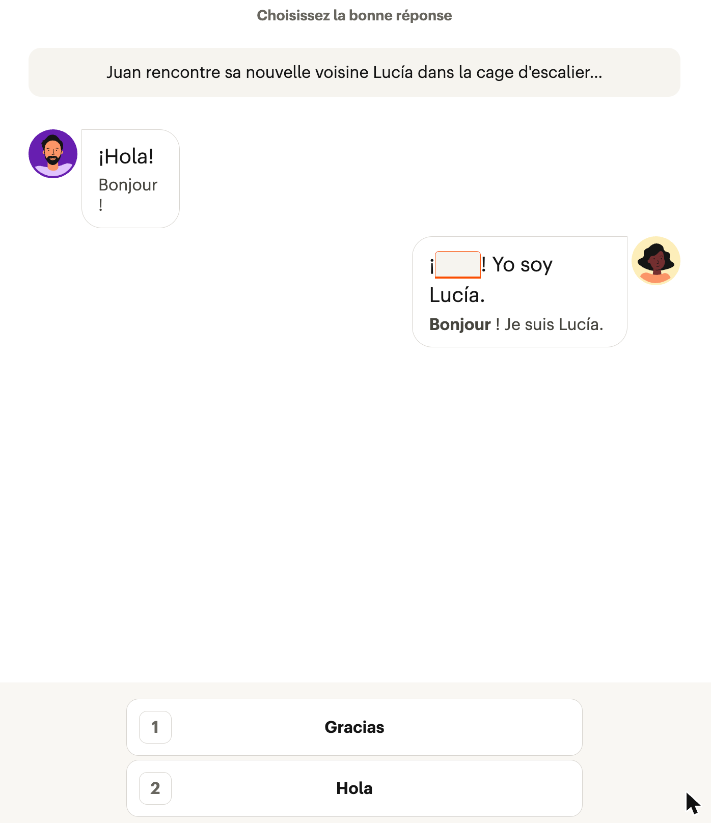
Babbel lesson 1, dialogue exercise (web, 21 October 2026).
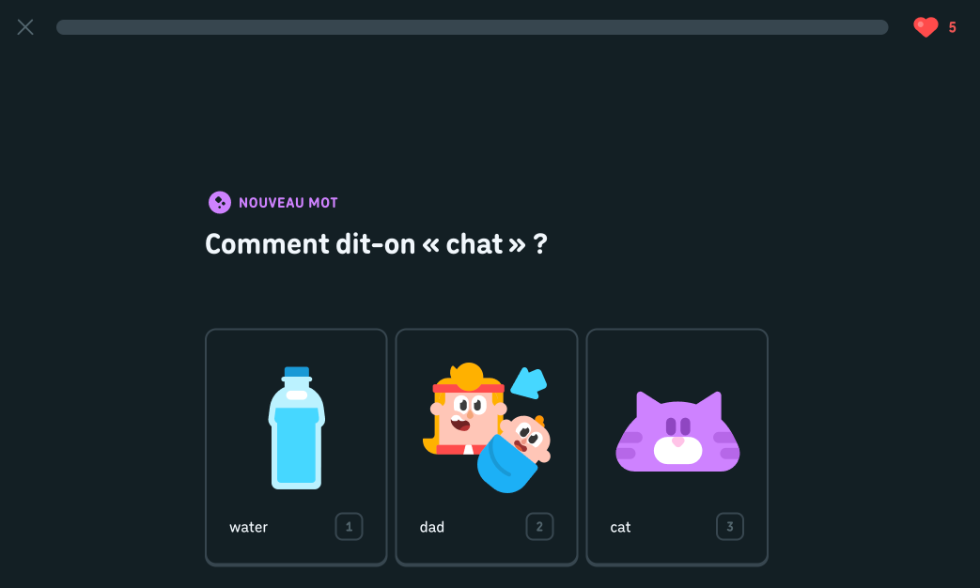
Duolingo, English for French speakers, lesson 1, first exercise (web, 21 October 2026).
Speaking and pronunciation
Babbel’s French course page says its voice recognition tool and Babbel Speak feature let learners practise pronunciation in conversational contexts (Babbel French course). Those are vendor claims. How accurately the feature recognises speech, especially for accents, has not been checked for this article.
We did not evaluate speech recognition in either app. Our test could not hear audio or speak, lesson 1 on the web had no speaking exercise. Duolingo’s lesson 1 had one, “Prononce cette phrase: Mom! Dad!”, which we skipped by choosing “Je ne peux pas parler”, an option that turns the microphone off for 15 minutes. So we cannot say whether either app accepts, corrects or rejects correct pronunciation.
Languages
Babbel offers 14 languages, all included in every plan, and does not teach Arabic (Babbel prices). Duolingo teaches Arabic and 40+ language courses, as listed on its Super page. If Arabic is your language, Duolingo is the option here that covers it.
Who should pick which
Pick Babbel if:
- you want grammar explained in a structured, levelled course,
- you are learning a language that Babbel covers well, such as French, Spanish or German,
- you are willing to pay a subscription or a one-time Lifetime fee, and want lessons that do not feel like a game,
- you are studying for a level such as A2 or B1 and want a course mapped to CEFR.
Pick Duolingo if:
- you want to start for free and decide later whether to pay,
- you want a daily habit with reminders and streaks,
- you want a language that Babbel does not offer, such as Arabic,
- you already have a teacher or conversation partner and need the app as a supplement.
Many learners use both: a free app for daily practice and a structured course for grammar. If budget is tight, start with the free option.
Pros and cons
Babbel
- Pro: structured levels and clear grammar explanations.
- Pro: short lessons that fit into a busy day.
- Con: no meaningful free tier beyond trial lessons.
- Con: 14 languages and no Arabic, against Duolingo’s wider list.
Duolingo
- Pro: a free version that covers a lot of content.
- Pro: strong habit-building features, including streaks and reminders.
- Con: lessons can feel repetitive, and explanations of grammar are shorter.
- Con: the free version shows ads and limits some features.
How to decide in ten minutes
Most learners can settle this without a trial marathon. Work through these questions in order:
- What is your budget for the next six months? If the answer is zero, Duolingo is the only option here that you can use without paying. If you can spend a subscription fee each month, Babbel becomes a realistic choice. On the 12-month plan, Babbel costs €7.99 per month.
- Do you want to understand why a sentence is built the way it is? If yes, look for a course with explanations. Babbel’s course pages describe grammar and culture notes in each lesson. If you mostly want repetition and vocabulary, Duolingo’s exercise format may be enough.
- How much time do you have each day? Both apps are built for short sessions. Babbel describes its lessons as five to ten minutes. Pick the one you will open on a bad day, because consistency matters more than the features.
- Will you speak with someone? Neither app replaces a teacher or a conversation partner. If you plan to book lessons with a human, the app can be a supplement and the cheaper option may be the free one.
- Which languages do you need? Check the language list in each app first. If your language is missing from one of them, the decision is already made.
If you cannot decide, run the free app for two weeks while you work out what you want from the paid one. That costs nothing and tells you more than any comparison table.
Frequently asked questions
Is Babbel better than Duolingo? Neither app is better for everyone. Babbel is usually the stronger choice for structured grammar and a paid course. Duolingo is usually the stronger choice for a free start and a daily habit.
Is Duolingo free? The core app is free, with ads, according to third-party reviews. The Super subscription removes ads and adds features, and has a one-week free trial (Duolingo Super). Check the current terms on duolingo.com.
Does Babbel have a free version? Babbel offers a free lesson to try, as shown on its French course page. The full course requires a subscription.
Can you become fluent with only one of these apps? Neither app promises fluency. Both work best alongside speaking with a person and reading or listening to real material in the language.
Which app is cheaper over a year? On Babbel’s official prices page, the 12-month plan is €95.88 per year in France. Duolingo does not publish Super prices on its Super page, so compare the price shown in the app for your country.
Related reading
Try Babbel or visit Duolingo.